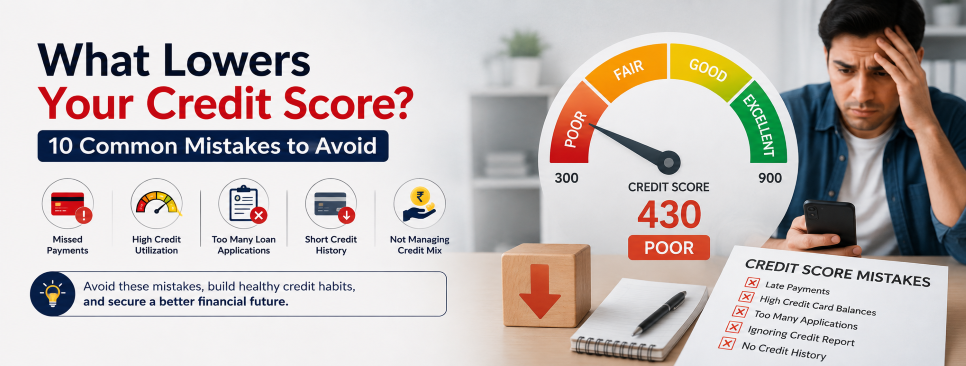
Wondering what lowers your credit score? Discover the 10 most common credit score mistakes, why your score drops, and how to fix it fast. Check yours free today.
If you've been asking yourself "why is my credit score going down" even though you feel like you're managing money responsibly, you're not alone. Every week, thousands of borrowers in Bangalore and across India get their loan applications rejected or approved at higher interest rates, and most of them don't know exactly what lowers your credit score in the first place.
A credit score isn't just a number. It's the first thing banks, NBFCs, and fintech lenders look at before approving your personal loan, credit card, or home loan. A drop of even 30-40 points can be the difference between a 10.5% interest rate and a 16% one, or between approval and rejection.
In this guide, we'll break down the 10 most common credit score mistakes that quietly damage your CIBIL score, backed by real lending patterns we see at FixRupee, and show you exactly how to fix and prevent them.
Before you read further, it helps to know where you stand. You can run a free credit score check in under two minutes, it won't hurt your score, and it gives you a baseline to measure improvement against.
What Is a Credit Score and Why Does It Matter?
A credit score is a three-digit number, typically between 300 and 900, that reflects how reliably you repay debt. In India, CIBIL, Experian, Equifax, and CRIF High Mark are the four bureaus that calculate this score using your credit history.
Lenders use this number to answer one question: how risky is it to lend you money? A score above 750 is generally considered good and unlocks better interest rates, higher loan amounts, and faster approvals. Anything below 650 puts you in the "high risk" category, where low credit score applicants either get rejected outright or charged a risk premium on interest.
Here's what most people don't realize: your score isn't static. It's recalculated every time a bureau receives new data from your bank, which means the mistakes below can start hurting you within 30-45 days.
What Lowers Your Credit Score? 10 Common Mistakes to Avoid
1. Missing or Delaying Credit Card Payments
Missed credit card payments are the single biggest score killer. Payment history makes up roughly 35% of your credit score calculation. Even one payment reported as "late" by 30+ days can pull your score down by 50-100 points, and it stays on your report for up to 7 years.
Fix: Set up auto-pay for at least the minimum due, and pay the full statement amount whenever possible to also avoid high interest charges.
2. Maxing Out Your Credit Cards (High Credit Utilization)
High credit utilization, using too much of your available credit limit, is the second-biggest factor. If your credit limit is ₹1,00,000 and you're consistently using ₹80,000-90,000 of it, bureaus read this as financial stress, even if you pay on time.
Fix: Keep utilization under 30% of your total limit. If you have a ₹1,00,000 limit, try to stay below ₹30,000 in outstanding balance before your statement date.
3. Making Late Loan Payments
Late loan payments on personal loans, EMIs, or business loans behave exactly like missed credit card payments, they get reported to bureaus and directly reduce your score. Unlike a credit card, loan EMIs are often auto-debited, so a bounced EMI due to insufficient balance is a common, avoidable trigger.
Fix: Maintain a buffer in your linked bank account 2-3 days before every EMI date.
4. Applying for Too Many Loans or Cards at Once
Every time you apply for credit, the lender runs a "hard inquiry" on your credit report. Multiple hard inquiries within a short window signal to bureaus that you're desperate for credit, a major red flag known as "credit hungry behaviour."
Fix: Space out loan or card applications by at least 3-6 months, and use eligibility checkers (which run soft inquiries) before formally applying.
5. Closing Old Credit Card Accounts
Closing your oldest credit card feels like decluttering, but it shortens your average credit history length and reduces your total available credit, which can spike your utilization ratio overnight.
Fix: Keep old accounts open and active with small, occasional transactions, even if you rarely use them.
6. Having a Poor Credit Mix
Bureaus reward borrowers who can responsibly manage both secured loans (home loan, car loan) and unsecured credit (credit cards, personal loans). Relying only on unsecured debt is one of the lesser-known factors that lower credit score.
Fix: You don't need to take a loan just to diversify, but if you already have one type, avoid stacking multiple unsecured loans simultaneously.
7. Errors or Fraud in Your Credit Report
Credit report mistakes are more common than people assume, a loan you closed still showing "active," a payment marked late when it wasn't, or even someone else's data merged into your file due to a PAN mismatch.
Fix: Review your credit report every quarter. If you spot an error, raise a dispute directly with the bureau; it's free and usually resolved within 30 days.
8. Settling Loans Instead of Paying in Full
A "settled" status on your credit report looks better than a default, but it still tells lenders you didn't repay the full amount owed. This is one of the most damaging and long-lasting entries on a credit file.
Fix: If you're struggling to repay, negotiate a restructured repayment plan with your lender instead of a settlement, it protects your score far better.
9. Co-Signing or Guaranteeing a Loan for Someone Else
When you co-sign or act as a guarantor, that loan appears on your credit report too. If the primary borrower misses payments, your score takes the hit, even though you never touched the money.
Fix: Only co-sign for people you trust completely, and monitor the loan's repayment status alongside them.
10. Not Checking Your Credit Score Regularly
This might be the most overlooked mistake. Many borrowers only check their score when a loan gets rejected, by then, the damage has already compounded for months. Regular monitoring through free credit score optimization tools helps you catch dips early and act before they snowball.
Fix: Check your score monthly. It's free, doesn't affect your score, and helps you course-correct early. Run your free credit score check here.
Why Is My Credit Score Going Down? A Quick Diagnostic
If your score has recently dropped, ask yourself:
- Did I miss or delay any EMI or credit card payment in the last 2 months?
- Is my credit card balance close to the limit right now?
- Did I apply for a new loan or card recently?
- Did I close an old credit account?
- Has anyone used my details as a co-applicant or guarantor?
If you answered "yes" to any of these, you've likely found your reasons for your credit score drops. The good news: unlike many financial problems, credit score damage is almost always reversible with consistent, disciplined repayment behaviour over 3-6 months.
How to Improve Credit Score: A Step-by-Step Approach
Knowing how to improve credit score is simpler than most people expect. Here's a practical sequence:
- Pull your free credit report and identify errors or overdue accounts.
- Clear overdue payments first, even small overdue amounts hurt disproportionately.
- Bring utilization below 30% by paying down credit card balances before the statement date.
- Avoid new credit applications for the next few months.
- Set up auto-pay for every EMI and credit card bill.
- Recheck your score monthly to track progress and catch new issues early.
Borrowers who follow this consistently typically see measurable improvement within 3-4 billing cycles, since bureaus update scores as soon as new repayment data comes in.
Does a Low Credit Score Affect Personal Loan Approval?
Yes, significantly. Most banks and NBFCs in India expect a minimum CIBIL score of 700-750 for standard personal loan approval at competitive interest rates. If your score is lower, you may still qualify through NBFCs and fintech lenders, though typically at a higher interest rate.
If you're currently dealing with a low credit score but need funds urgently, read our detailed guide on getting a personal loan with a low credit score, and check the exact minimum CIBIL score required for a personal loan across major lenders.
Once your score improves, you can explore FixRupee's personal loan options for better rates and faster approval.
FAQs: What Lowers Your Credit Score
1. What is the biggest factor that lowers your credit score?
Missed or late payments are the single biggest factor, accounting for roughly 35% of your credit score calculation. Even one missed payment can significantly lower your score.
2. How long does a credit score drop stay on my report?
Negative entries like missed payments or settlements typically remain on your credit report for up to 7 years, though their impact on your score reduces over time as you build a positive repayment history.
3. Does checking my own credit score lower it?
No. Checking your own score is a "soft inquiry" and has zero impact on your credit score. Only "hard inquiries" from lenders during a formal loan or card application can cause a small, temporary dip.
4. Can a low credit score be fixed quickly?
Some improvement can happen within 30-45 days if you clear overdue payments and lower your credit utilization. However, a full recovery from a significantly low score usually takes 3-6 months of consistent, on-time repayment.
5. Does closing a credit card improve or hurt my credit score?
Closing a credit card usually hurts your score, since it reduces your overall available credit and shortens your credit history length, both of which can increase your utilization ratio.
6. How often should I check my credit score?
Ideally once a month. Regular monitoring helps you catch errors or unexpected dips early, before they affect a loan or credit card application.
Final Thoughts: Take Control of Your Credit Score Today
Understanding what lowers your credit score is the first step to protecting your financial future. From missed payments and high utilization to frequent loan applications, most of these mistakes are avoidable with a little awareness and discipline.
The best way to stay ahead is to track your score consistently instead of waiting for a loan rejection to find out something's wrong.
Ready to see where you stand? Get your free credit score check and personalized optimization tips at FixRupee →