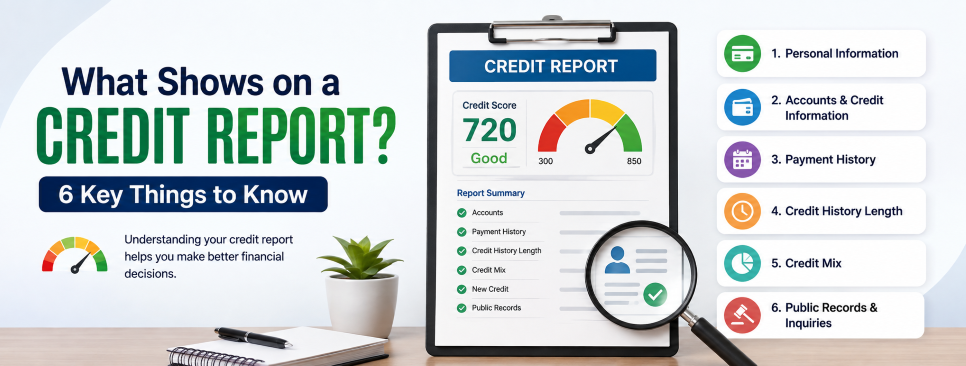
Wondering what shows on a credit report? Discover the 6 key details lenders check, how to read your CIBIL report, and how to fix errors fast.
Introduction
You apply for a personal loan. You've never missed a bill in your life. And yet, the bank rejects your application, or worse, offers you an interest rate that feels like a punishment.
What happened?
The answer usually lives in one document you've probably never opened: your credit report. Most people in Bangalore, and across India, only think about their credit report the moment a loan gets rejected. By then, it's too late to fix the damage quietly.
Understanding what shows on a credit report before you apply for credit is one of the smartest financial habits you can build. It's the difference between walking into a bank with confidence and walking in blind.
In this guide, we'll break down exactly what appears on a credit report, why each section matters to lenders, and how you can use that knowledge to strengthen your credit profile. We'll also show you how to run a free credit score check so you're never caught off guard again.
What Is a Credit Report? A Quick Definition
A credit report is a detailed record of your borrowing and repayment behavior, compiled by credit bureaus like CIBIL, Experian, Equifax, and CRIF High Mark. Banks and NBFCs pull this report every time you apply for a loan or credit card to judge how risky it is to lend you money.
Think of it as your financial report card. Every loan you've taken, every EMI you've paid (or missed), and every credit card you hold gets logged here. In India, the CIBIL report is the most widely used version of this document, and your CIBIL score, a three-digit number between 300 and 900, is calculated directly from the information inside it.
So when someone asks "what does a credit report show," the honest answer is: almost everything about how you handle money.
What Shows on a Credit Report? 6 Key Things to Know
Let's get into the core of it. Here are the six categories of information on a credit report that every lender in India looks at before approving your loan or credit card.
1. Personal Information
This is the identity section of your report. It typically includes:
- Full name and any aliases
- Date of birth
- PAN number
- Address history
- Phone numbers and email IDs
- Employment details (in some reports)
This section doesn't directly affect your score, but accuracy matters. A wrong PAN or outdated address can cause verification delays or, worse, get your file mixed up with someone else's, a common but serious error. Always check this section first when you review your credit report details.
2. Credit Accounts (Account Status)
This is where every loan and credit card you've ever held gets listed, home loans, personal loans, car loans, credit cards, even that gold loan you took two years ago.
For each account, the report shows:
- Type of loan or credit
- Lender name
- Date opened and closed
- Loan amount or credit limit
- Current account status, active, closed, settled, or written off
Lenders scan this section to understand your borrowing pattern. Too many active loans at once, or a string of "settled" accounts instead of "closed," can raise red flags. A settled account tells a lender you paid less than what you owed, which looks very different from a loan closed in full.
3. Payment History
If personal information is the identity section, payment history is the credibility section, and it's the single biggest factor influencing your credit score.
This part shows, month by month, whether you paid your EMIs and credit card bills on time. It's usually represented with codes like:
- 000 — paid on time
- 030, 060, 090 — payment delayed by 30, 60, or 90 days
- XXX — no data available for that month
A single missed payment can stay visible on your report for years. According to industry data, payment history typically accounts for roughly 30-35% of how your credit score is calculated, making it more influential than almost any other factor. This is exactly why even one late EMI can quietly chip away at your score, even if you eventually paid it off.
4. Credit Inquiries
Every time you (or a lender, on your behalf) check your credit report, it gets logged as an inquiry. There are two types:
- Soft inquiries — checking your own score, or a lender doing a preliminary check. These don't affect your score.
- Hard inquiries — a formal application for a loan or credit card. These do affect your score, especially if there are several in a short period.
A cluster of credit inquiries within a few weeks signals to lenders that you might be "credit hungry", applying to multiple banks at once because you're desperate for funds. This is one of the most overlooked reasons people get rejected even with a decent score. If you're planning to apply for credit, it helps to know the minimum CIBIL score for a personal loan beforehand, so you're not applying blindly to multiple lenders.
5. Outstanding Debt and Credit Limits
This section shows exactly how much you currently owe across all your loans and cards, alongside your credit limits on each card.
Two numbers matter here:
- Total outstanding debt — the sum of everything you owe right now
- Credit utilization ratio — how much of your available credit limit you're actually using
For example, if your credit card limit is ₹1,00,000 and your outstanding balance is ₹80,000, your utilization ratio is 80%, a level most lenders consider risky. Financial experts generally recommend keeping utilization below 30% to maintain a healthy score. High outstanding debt relative to your limits is one of the fastest ways to pull your score down, even if you're paying on time.
6. Public Records and Credit History Length
The final section covers public records, legal and financial red flags such as:
- Loan defaults
- Bankruptcy filings
- Court judgments related to unpaid debt
- Written-off or settled loan accounts
Alongside this, your report also reflects your overall credit history, how long you've been using credit at all. A longer, well-managed credit history builds trust with lenders. If you're new to credit, don't worry, everyone starts somewhere. But if you're rebuilding after a rough patch, understanding how to get a personal loan with a low credit score can help you plan your next steps realistically.
How to Read a Credit Report (Without Feeling Overwhelmed)
Most people open their credit report, see a wall of numbers and codes, and immediately close it. Here's a simple step-by-step way to actually read it:
- Start with your score — usually displayed at the top. This gives you the headline number before you dig into details.
- Check personal information for errors — wrong PAN, old address, or misspelled name.
- Scan account status — make sure every closed loan actually says "closed," not "settled" or "written off" by mistake.
- Review payment history codes — look for any 030, 060, or 090 entries you didn't expect.
- Count recent inquiries — if you see more than 2-3 in the last six months, that's likely affecting your score.
- Look for unfamiliar accounts — this is how you catch identity theft or fraudulent loans early.
Doing this once every few months takes less than 10 minutes and can save you from a nasty surprise at loan application time.
Why Checking Your Credit Report Regularly Matters
Here's a real-world scenario we see often: a salaried professional in Bangalore applies for a car loan, confident about approval. The loan gets rejected. On checking the report, they discover a credit card they closed two years ago is still showing as "active" with an outstanding balance, a reporting error by the bank that was never corrected.
This isn't rare. Errors on credit reports are more common than most people assume, and they can sit unnoticed for years simply because nobody checks. A free credit score check isn't just about vanity, it's a diagnostic tool that helps you catch these issues before a lender does.
Regularly reviewing your report also supports free credit score optimization, small, consistent actions like disputing errors, reducing utilization, and spacing out loan applications that compound into a meaningfully stronger score over time. Want a deeper breakdown of the process? Read our complete guide on free credit score checks.
What Does a Good Credit Report Actually Look Like?
To sum up what lenders want to see:
- Accurate personal details with no mismatches
- On-time payment history across all accounts
- Low credit utilization, ideally under 30%
- Few recent hard inquiries
- No public records like defaults or write-offs
- A reasonably long, well-managed credit history
If your report checks most of these boxes, you're in a strong position to negotiate better interest rates, not just get approved.
FAQs: What Shows on a Credit Report
1. What information is included in a credit report?
A credit report includes your personal details, all credit accounts and their status, payment history, credit inquiries, outstanding debt, credit limits, and any public records like defaults or settlements.
2. How is a CIBIL report different from a general credit report?
A CIBIL report is the specific version of a credit report generated by TransUnion CIBIL, one of India's major credit bureaus. It contains the same core categories of information but is formatted according to CIBIL's scoring model, which most Indian banks and NBFCs rely on.
3. Does checking my own credit report lower my score?
No. Checking your own report counts as a soft inquiry, which has no impact on your credit score. Only hard inquiries, triggered when you formally apply for credit, can affect your score.
4. How often should I check what shows on my credit report?
Ideally, once every 3 months, or before any major loan or credit card application. This gives you enough time to fix errors or improve weak areas before a lender reviews your file.
5. Can I remove incorrect information from my credit report?
Yes. You can raise a dispute directly with the credit bureau (like CIBIL) or your lender. Corrections typically take 30-45 days to reflect once verified.
6. Where can I check my credit report for free?
You can run a free credit score check through FixRupee to instantly view your score and get a snapshot of what's affecting it, no cost, no hidden charges.
Final Thoughts: Take Control of What Shows on Your Credit Report
Your credit report isn't just a formality lenders glance at, it's the single most important document shaping your access to loans, credit cards, and better interest rates. Now that you know exactly what appears on a credit report, personal information, credit accounts, payment history, inquiries, outstanding debt, and public records, you're in a far better position to manage it proactively instead of reactively.
Don't wait for a loan rejection to find out what's on your report. Check it today, catch errors early, and build a credit profile that works in your favor.
Ready to see where you stand? Get your free credit score check with FixRupee today, and once your credit profile is strong, explore the best credit card options matched to your score and spending needs.