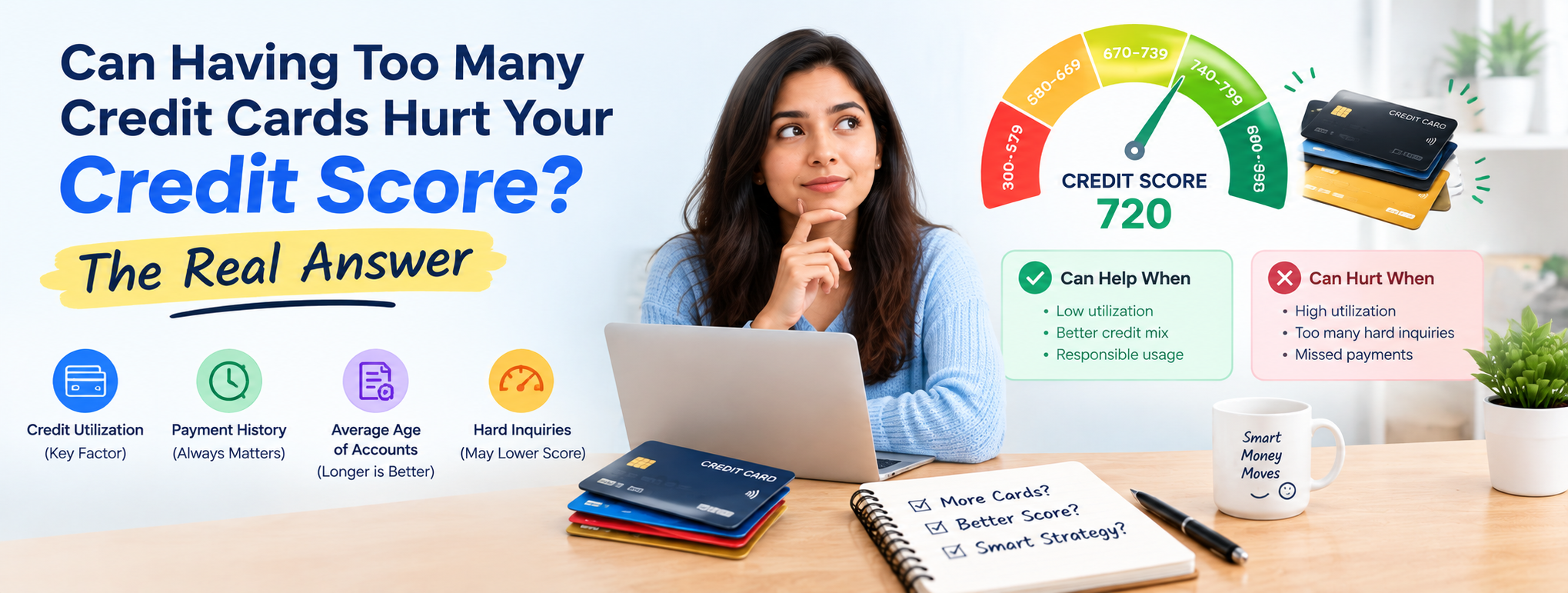
If your wallet is starting to look like a deck of cards, you've probably asked yourself this question at least once: can having too many credit cards hurt your credit score? It's a fair worry. Banks keep sending pre-approved offers, reward points sound tempting, and before you know it, you're holding four or five cards instead of one.
Here's the short answer: the number of cards you own isn't the real problem, how you use them is. A person with five well-managed cards can have a better credit score than someone with just one card that's maxed out every month. But there are specific situations where too many credit cards can hurt your credit score, and this guide breaks down exactly when, why, and how to avoid it.
We'll cover how credit bureaus like CIBIL, Experian, and Equifax actually look at multiple credit cards, what credit card utilization ratio really means, how hard inquiries affect your score, and how many credit cards are genuinely too many for someone in India. By the end, you'll know exactly how to manage multiple credit cards without damaging your credit history.
Does Having Multiple Credit Cards Affect Credit Score?
Having multiple credit cards does not automatically lower your credit score. In fact, owning several credit cards can help your score if:
- You keep your credit utilization ratio low across all cards
- You pay every bill on time, every month
- You maintain a healthy mix of old and new accounts
- You don't apply for too many cards in a short period
However, too many credit cards can hurt your credit score when they lead to missed payments, high outstanding balances, frequent hard inquiries, or poor account management. The number itself is neutral, your behavior with those cards is what moves the needle.
How Credit Bureaus Actually Score Multiple Credit Cards
To understand whether too many credit cards affect your credit score, it helps to know what credit bureaus actually measure. In India, CIBIL (and other bureaus like Experian and Equifax) calculate your score using a few core factors:
- Payment history (around 30–35% weight) — Do you pay on time, every time?
- Credit utilization ratio (around 25–30% weight) — How much of your available credit are you using?
- Credit history length (around 15% weight) — How long have your accounts been open?
- Credit mix (around 10% weight) — Do you have a healthy balance of credit cards, loans, and other credit types?
- New credit / hard inquiries (around 10% weight) — How often have you applied for new credit recently?
Notice that "number of credit cards" isn't a direct factor. What matters is how your cards influence utilization, payment history, and inquiries. This is exactly why understanding your credit score and what actually moves it is more useful than just counting cards in your wallet.
When Too Many Credit Cards Can Hurt Your Credit Score
Let's get specific. Here are the real scenarios where having multiple credit cards can lower your credit score.
1. High Credit Card Utilization Across Multiple Cards
Your credit card utilization ratio is the percentage of your total available credit that you're currently using. For example, if you have a combined credit limit of ₹3,00,000 across all your cards and your outstanding balance is ₹1,50,000, your utilization ratio is 50%.
Lenders and credit bureaus generally like to see this ratio below 30%. The lower, the better. Many financially healthy borrowers keep it under 10%.
Here's the twist: more cards can actually help your utilization ratio, as long as you don't spend more just because you have more credit available. The problem happens when people treat multiple cards as extra spending money rather than extra available credit. Running high balances on several cards at once, even if each individual card isn't maxed out, can push your overall utilization ratio into risky territory and directly hurt your score.
Example: Priya has three credit cards with limits of ₹50,000, ₹1,00,000, and ₹1,50,000 (total ₹3,00,000). If she carries balances of ₹20,000, ₹60,000, and ₹90,000, her total utilization is ₹1,70,000 / ₹3,00,000 = 56.6%. Even though no single card is maxed out, her overall utilization is high enough to drag her score down.
2. Too Many Hard Inquiries From Multiple Applications
Every time you apply for a new credit card, the lender runs a hard inquiry on your credit report. A single hard inquiry usually has a small, temporary impact. But applying for several cards within a short window, say, three or four applications in two months, signals "credit hungry" behavior to lenders and bureaus.
This is one of the most common ways people unintentionally hurt their credit score. If you're planning to apply for a loan soon too, spacing out your credit card applications matters even more. Many readers also ask whether you can apply for a credit card and a loan at the same time. The short version is yes, but timing and sequencing matter a lot for your approval odds.
3. A Lower Average Age of Credit Accounts
Credit age matters more than most people realize. Opening several new credit cards in a short span of time pulls down the average age of all your accounts, since new accounts are, well, new. A shorter average credit history can make your profile look less stable to lenders, even if your payment behavior is excellent.
This is why financial experts often recommend keeping your oldest card open and active, even if you rarely use it, rather than closing it.
4. Missed Payments Become More Likely
This one is simple but important: more cards mean more due dates, more statements, and more chances to forget a payment. A single missed payment can stay on your credit report for years and cause a noticeable score drop. If you're not using a tracking system, the sheer complexity of juggling multiple credit card bills can quietly work against you.
5. Higher Temptation to Overspend
This isn't a bureau-measured factor directly, but it's the root cause behind most of the issues above. Multiple cards mean more available credit, and more available credit can tempt people into spending beyond their means. The resulting high balances and missed payments are what actually damage the score, not the cards themselves.
When Multiple Credit Cards Can Actually Help Your Credit Score
It's not all risk. Here's how having more than one credit card, used responsibly, can work in your favor.
More Available Credit Can Lower Your Utilization Ratio
If you spend the same amount every month but have more total credit limit spread across cards, your utilization ratio naturally goes down, as long as you don't increase your spending to match. This is one of the fastest ways people legitimately improve their score without changing their spending habits.
A Stronger Credit Mix
Credit bureaus like to see that you can responsibly manage different types of credit. Multiple cards, especially from different categories (a cashback card, a travel card, a fuel card), can demonstrate financial maturity when paired with good repayment behavior.
Backup During Emergencies
Having more than one active card gives you flexibility. If one card has a technical issue, hits its limit, or gets temporarily blocked, you have a backup, reducing the risk of a missed or late payment due to circumstances outside your control.
Access to More Rewards and Benefits
Different cards often come with different reward structures, cashback on groceries, points on travel, discounts on fuel. Choosing the right mix of credit cards for your spending pattern can genuinely save money, as long as utilization and payments stay disciplined.
How Many Credit Cards Are Too Many?
There's no official number written into any credit scoring formula — but based on industry patterns and how Indian lenders typically assess risk, here's a practical guide:
| Number of Cards | General Risk Level | Notes |
|---|---|---|
| 1 card | Low risk, but limited credit mix and lower total available credit | Fine for beginners building credit |
| 2–4 cards | Generally healthy if managed well | Sweet spot for most salaried professionals |
| 5–7 cards | Manageable but requires discipline | Needs strong tracking systems and low utilization |
| 8+ cards | Higher risk of overspending, missed payments, and inquiry-related dings | Only advisable for highly disciplined, high-income users |
Most financial advisors in India suggest that 2 to 4 cards is a comfortable range for most working professionals, enough to build a solid credit mix and keep utilization low, without the administrative burden of tracking too many due dates.
If you're just starting out, you might only have one card, and that's completely fine too. Building credit from scratch in India usually starts with a single well-managed card before expanding.
Does Closing a Credit Card Help or Hurt Your Score?
If you're worried about having too many cards, your first instinct might be to close a few. Be careful, this can backfire.
Closing a credit card:
- Reduces your total available credit, which can instantly raise your utilization ratio even if your spending stays the same
- Can shorten your average credit age, especially if you close your oldest account
- Removes a line of credit history from your active profile
Before closing any card, read through what to check before closing a credit card so you don't accidentally hurt the score you're trying to protect. In most cases, it's better to simply stop using a card (while keeping it open and making the occasional small purchase to keep it active) than to close it entirely.
How to Manage Multiple Credit Cards Without Hurting Your Score
Here's a practical, step-by-step approach to managing several credit cards responsibly.
Step 1: List All Your Cards and Due Dates
Write down every card you own, its credit limit, due date, and minimum payment. This single step eliminates most accidental missed payments.
Step 2: Set Up Auto-Pay for at Least the Minimum Due
Even if you plan to pay in full, set auto-pay for the minimum amount due as a safety net. This protects your payment history even if you forget.
Step 3: Keep Total Utilization Under 30%
Add up your balances across all cards and divide by your total credit limit. Aim to stay under 30%, and ideally under 10% for the best score impact.
Step 4: Space Out New Applications
Avoid applying for more than one new card every 3–6 months. This limits hard inquiries and protects your average credit age.
Step 5: Review Your Credit Report Regularly
Check your credit report every few months to catch errors, unauthorized charges, or missed payments before they snowball. Knowing what actually shows up on your credit report helps you spot problems early.
Step 6: Use Different Cards for Different Purposes
Assign specific cards to specific spending categories (groceries, fuel, bills) so you can track usage more easily and avoid duplicate or forgotten charges.
Step 7: Avoid Common Score-Lowering Mistakes
A surprising number of people lower their own credit score without realizing it. It's worth reviewing common mistakes that lower your credit score so you know exactly what to avoid as you manage multiple cards.
Credit Cards vs. Personal Loans: Which Affects Your Score Differently?
If you're managing several credit cards and considering taking on more credit, it's worth understanding how credit cards compare to personal loans and their impact on your credit score. Credit cards are revolving credit (your utilization ratio matters continuously), while personal loans are installment credit (your score benefits more from consistent EMI payments over time). A healthy credit mix often includes both, used responsibly.
If you'd rather simplify things with a one-time purchase instead of adding another card to your wallet, it's also worth knowing that you can now buy a laptop on EMI without a credit card, a useful option when you want to avoid opening yet another revolving credit line.
Practical Scenarios: Real-World Examples
Scenario 1 — The Over-Applier: Rahul applied for four credit cards within two months to chase sign-up bonuses. Each application triggered a hard inquiry. His score dropped by 25–30 points within weeks, even though he hadn't missed a single payment. Lesson: timing your applications matters as much as managing your existing cards.
Scenario 2 — The Balanced User: Anjali has four credit cards with a combined limit of ₹5,00,000. She keeps her total outstanding balance under ₹50,000 at all times and pays in full every month. Her utilization stays around 10%, and her score has steadily improved over three years. Lesson: more cards with disciplined usage can be better than one card used carelessly.
Scenario 3 — The Accidental Defaulter: Vikram has six cards and genuinely forgot about a due date on a card he rarely uses. The missed payment stayed on his report for years, hurting his score far more than the convenience of that extra card was worth. Lesson: every active card is a responsibility, not just a benefit.
If you're ever unsure about cash-related transactions on your card, it also helps to review things to check before a credit card cash withdrawal, since these can carry extra fees and interest that quietly raise your utilization.
So, Is Having Multiple Credit Cards Bad?
No, not inherently. Having multiple credit cards is bad for your credit score only when it leads to high utilization, missed payments, excessive hard inquiries, or a shortened average credit age. Managed well, multiple cards can actually strengthen your credit profile by lowering utilization and broadening your credit mix.
If you're unsure whether your current card setup is helping or hurting your score, it's worth taking stock of your overall credit health. You can also explore options like a personal loan if you'd prefer to consolidate high-interest credit card debt into a single, more manageable EMI, which can also help bring your utilization ratio down. And if your score needs a quicker boost before a big application, these tips on how to improve your credit score fast and how to improve your CIBIL score in India are worth a read too.
FAQs: Too Many Credit Cards and Your Credit Score
1. How many credit cards are too many?
There's no fixed number, but most financial advisors suggest 2–4 cards is comfortable for most people. Beyond 5–7 cards, managing due dates and utilization becomes significantly harder, raising the risk of missed payments.
2. Does having multiple credit cards lower your credit score immediately?
No. Simply owning multiple cards doesn't lower your score. Your score is affected by how you use them, utilization ratio, payment history, and how often you apply for new credit.
3. Will closing a credit card improve my credit score?
Not necessarily. Closing a card reduces your total available credit, which can raise your utilization ratio and potentially lower your score. It's usually better to keep unused cards open unless there's an annual fee you want to avoid.
4. Does applying for multiple credit cards at once hurt my score?
Yes. Each application triggers a hard inquiry, and multiple inquiries within a short period can signal risk to lenders, temporarily lowering your score. Space out applications by at least a few months.
5. What is a good credit card utilization ratio?
Keep your total utilization under 30% across all cards, with under 10% being ideal for the best possible score impact.
6. Can having too many credit cards affect my loan approval?
Yes, indirectly. Lenders review your overall credit profile, including total available credit, utilization, and recent inquiries, when assessing loan applications. A messy multi-card profile with high utilization or missed payments can reduce your approval odds. If you're building credit from the ground up or want a refresher on the basics, what is a credit score and why it matters and common credit score myths debunked are good starting points, along with what shows up on your credit report and a good credit score for a small business loan.
Final Takeaway
To answer the original question directly: too many credit cards don't hurt your credit score on their own, poor management does. Whether you have one card or seven, the fundamentals stay the same: keep your utilization low, pay on time every time, and avoid applying for new credit too frequently.
If you're currently juggling multiple cards and want to simplify your finances or improve your score faster, explore your options with FixRupee. Check your eligibility and start your loan application today to take control of your credit health.